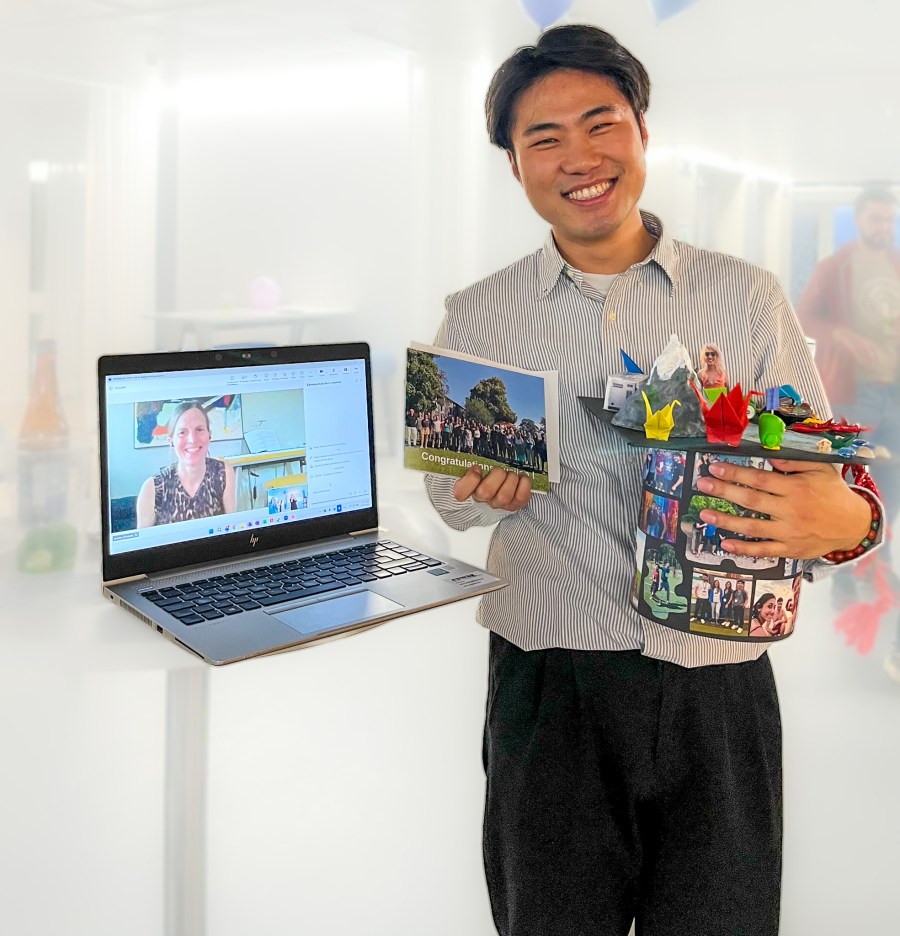
We are excited to share a major milestone for our team: the very first PhD defense within the project has been successfully completed!
On 16 January, Xuejian defended his dissertation titled “Portfolio of Cyanobacterial Secondary Metabolites and Their Biotransformation in Surface Waters.”
His work provides valuable insights into the diversity of cyanobacterial metabolites and how these compounds transform within aquatic environments—an important contribution to our project’s scientific foundation.
We are back at the International Conference on Toxic Cyanobacteria (ICTC13). This time this exciting conference is hosted in Crete. We are happy to be able to show what we have worked on since the beginning of the project and our first visit to the ICTC12 in 2022. You will be able to find us in many presentations and posters:
Presentations on May 5 SESSION 2: 11:44 –11:56 O10 – 77 | Updates of CyanoMetDB – a comprehensive public database of secondary metabolites from cyanobacteria with Elisabeth (Lilli) Janssen
SESSION 4: 17:24 –17:30 F5 – 4 | Portfolio of cyanobacterial secondary metabolites and their biotransformation potential in surface waters with Xuejian Wang
SESSION 5: 17:36 –17:42 F20 – 69 | Biotic interactions shape the realised niche of toxic cyanobacteria with Pinelopi Ntetsika
Posters P2-78 | Reactivity of cyanobacteria metabolites with ozone: Multi-compound competition kinetics and transformation products with Elisabeth (Lilli) Janssen
P110-69 | Biotic interactions shape the realised niche of toxic cyanobacteria with Pinelopi Ntetsika
P117-166 | Assessing direct and indirect effects of cyanotoxins on Daphnia: survival dynamics under different exposure scenarios with Agustina Ziliani
This year we encouter a Planktothrix rubescens bloom in Greifensee. This is fascinating as this is not a typical species to dominate this system. We will explore the emergence of this bloom and its metabolite profile.
Simon was a research assistant in the CyanoBloom project from the beginning. Now he is moving on and out of academia to work at Bachema AG. As an environmental scientist and chemist, he was working on the analysis of cyanopeptides. We were very happy to have him as part of our team and wish him all the best in his new job.
Almost two years have passed since we started this exciting project. We have been very busy and got a lot done: – We have run many experiments trying to understand how biofilm transforms cyanobacteria secondary metabolites, how zooplankton likes or dislikes feeding on cyanos and trying to understand how toxic and non-toxic strains of cyanobacteria behave under different conditions. – We have worked on new techniques in the lab: How can we grow different cyanobacteria strains together but also apart at the same time or how can we improve ecological theory computational methods to helps us understand their dynamics? – We have produced a lot of data in the lab, in the lake and in theory and are excited to dig into our findings and bring them onto paper soon. We also used as many opportunities as possible to benefit from each others knowledge and expertise. We are looking forward to another two exciting years ahead of us and wish everyone a merry holiday.
Last week, many of us joined the ALSO 2023 conference in Palma de Mallorca. After a week of listening, presenting, learning, chatting, eating and much more, we were all exhausted but happy.
We got inspired by a lot of presentations and talks while also being able to share the exciting work we do in our own and other sessions.
Of course, we would also enjoy the opportunity to enjoy Palma, the beach, the sun and the Spanish lifestyle with a lot of coffee, late dinners and drinks.
A large part of the cyanobloom team will join ASLO 2023 in Palma de Mallorca. The conference will take place June 4 – June 9. Cyanobloom will host the session SS097 What Mechanisms Drive Toxic Algal Blooms? that will take place Thursday 8th 8.30am – 10.00am in the Sala Palma. Do not miss the session and talk our team members (Xuejian Wang & Pinelopi Ntetsika) will give.
Xuejian installed two cages with glass slides at the monitoring platform in Greifensee. The cages are deployed underwater near the surface and are used to grow natural biofilms on glass slides. After 4 to 6 weeks’ growing, he will harvest the biofilms and spike cyanopeptides to learn about the biotransformation process of toxins/NRPs. The goal is to assess the biotransformation rates and find most the stable peptides.
Last week, CyanoBloom was at the 12th International Conference on Toxic Cyanobacteria in Toledo, Ohio. We were able to present our exciting research project, our ideas and visions. Our team was represented by Francesco, Lilli, Pinelopi and Agustina who held two presentations and presented a poster. They gained a lot of new insight and inspiration, exchanged with other scientists across the globe and enjoyed the social interactions after two years of isolation. Find our poster and the abstract here.
Deepthi was a master student and now an intern with David Johnson for a couple of months. As a biotechnologist and aspiring microbial ecologist, she was working on knocking out a toxic gene (mcy) from Microcystis aeruginosa. We were very happy to have her as part of our team and her contribution to the project.


 CyanoBloom